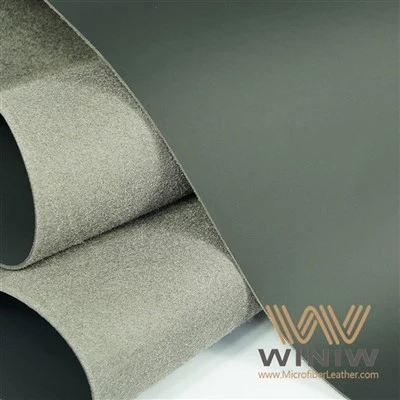
Stain-resistant micro suede is an engineered commercial upholstery textile utilizing a cross-linked fluorocarbon nano-coating applied over a DMF-free polyurethane sea-island matrix. This "three-proof" (water, oil, and soil) surface treatment lowers the material's surface tension to < 20 mN/m, permanently preventing the absorption of tannins, lipids, and chemical inks in high-traffic hospitality environments.
Surface Tension Modification in Commercial Upholstery Leather
Standard PU and woven fabrics fail rapidly in restaurant and hotel lobbies because their surface tension exceeds that of common liquid contaminants, leading to immediate capillary absorption. To engineer a highly functional Commercial upholstery leather, the manufacturing process integrates a hydrophobic and oleophobic nano-treatment during the final thermal curing phase (150°C).
This chemical modification alters the contact angle of the material to > 110°. Liquid droplets cannot break the surface energy barrier and instead bead up entirely on the microporous polyurethane surface. This physical blockade guarantees long-term hydrolysis resistance (> 5 Weeks, 70°C, 95% RH) since acidic liquids (like citrus juice or coffee) never reach the base polyethylene terephthalate (PET) fibers to induce polymer chain cleavage.
Procurement & QA Notice: Validating soil release metrics for an upcoming hospitality furniture project? Request a physical sample roll and our ISO 9001 certified laboratory Technical Data Sheet (TDS).
Request Physical Swatches & Lab TDS Report for Stain resistant faux suede
Stain Removal Metrics: Coffee, Wine, and Ink Resistance
QA validation for an Easy clean sofa fabric requires quantitative standardized chemical exposure testing. In rigorous laboratory settings, common commercial spills-tannins from red wine, lipids from food grease, and pigments from ballpoint pens-wipe off completely with a dry or slightly damp microfiber cloth, leaving zero residual ghosting.
The following matrix contrasts the fluid and soil resistance of standard commercial synthetics against WINIW treated micro suede.
| Testing Protocol | Contaminant Type | Standard PU Upholstery | WINIW Treated Micro Suede |
| Soil Release (AATCC 130) | Red Wine / Espresso | Grade 2 (Permanent Stain) | Grade 5 (Complete Removal) |
| Oil Repellency (AATCC 118) | Mineral Oil / Food Fat | Grade 1 (Rapid Penetration) | Grade 6 (No Penetration) |
| Ink Resistance | Blue/Black Ballpoint Pen | Irreversible chemical bond | 100% removal via 70% IPA wipe |
| Abrasion Resistance | 12 kPa Mechanical Load | 30,000 Rubs | > 100,000 Rubs (EN ISO 12947-2) |
| Peeling Strength | Interfacial Adhesion | ≤ 15 N/3cm | ≥ 30 N/3cm (ISO 2411) |
Beyond strict fluid resistance, commercial seating dictates rigorous fire and chemical compliance. The dense sea-island substrate inherently passes BS 5852 (Crib 5) and FMVSS 302 horizontal burn rate requirements (≤ 102 mm/min). Utilizing 100% water-borne PU systems ensures Volatile Organic Compound (VOC) emissions remain strictly ≤ 10 mg/kg, easily passing REACH Annex XVII SVHC restrictions for safe indoor air quality.
Frequently Asked Questions (FAQ)
Q: How does stain resistant faux suede repel red wine and coffee?
A: The material is treated with a fluorocarbon nano-coating during the high-temperature curing phase. This lowers the surface tension below 20 mN/m (contact angle > 110°), forcing aqueous and lipid-based liquids to bead up entirely rather than penetrating the 3D sea-island fiber matrix.
Q: What is the testing standard for easy clean sofa fabric?
A: Laboratories utilize AATCC 130 for soil release and AATCC 118 for oil repellency. Engineering-grade commercial micro suede consistently achieves a Grade 5 rating for coffee and wine release, and a Grade 6 rating for preventing lipid penetration.
Q: Does the anti-stain nano-coating reduce peeling strength or durability?
A: No. The nano-treatment is chemically bonded to the DMF-free polyurethane resin. The material maintains an ISO 2411 peeling strength of ≥ 30 N/3cm and endures > 100,000 Martindale abrasion rubs (EN ISO 12947-2) without losing its stain-repellent properties.