

B2B material selection for packaging manufacturers
Synthetic Leather for Packaging and Display
Synthetic leather for packaging has to do more than look premium. The material must work with the box board, insert, foam, adhesive, folding radius, printing or hot-stamping process and the way the finished package is stored and shipped.
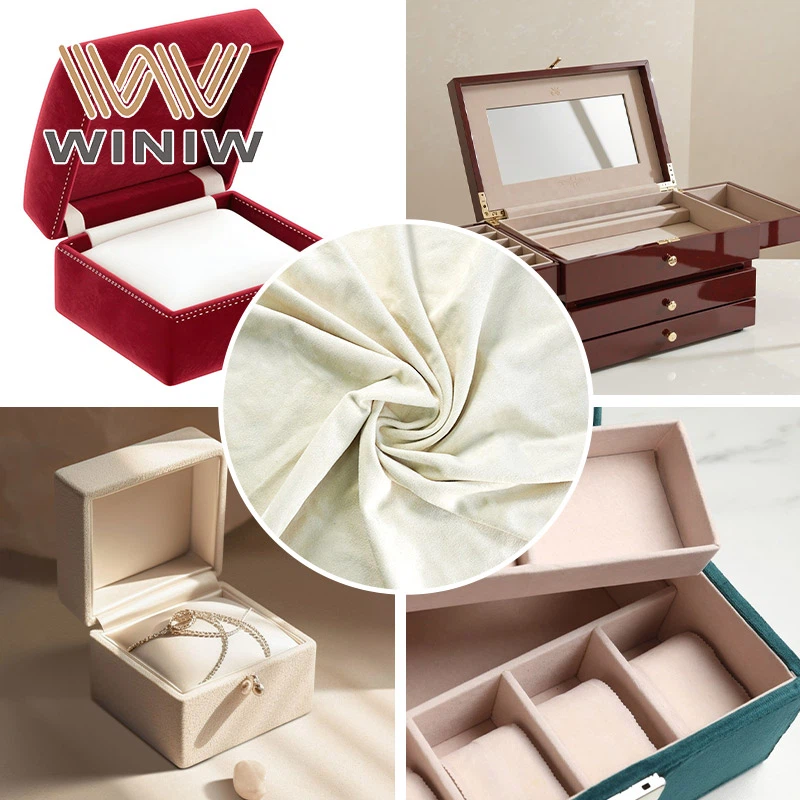
WINIW supplies material options for jewelry and watch boxes, retail displays, consumer-electronics packaging, menus, notebooks and gift packaging. Buyers can compare PU leather, PVC leather, microfiber leather, microsuede and silicone leather against the actual package construction before bulk approval.
Start With the Finished Package, Not the Leather Name
A ring box lining, a rigid electronics case and a menu cover place different demands on the same-looking surface. Define the package construction and converting process first, then select the leather route.

Jewelry & Watch Boxes
Review surface feel, visual uniformity, lining or wrapping construction, adhesive compatibility, odor requirements and contact with light-colored inserts or products.

Consumer Electronics
Match the leather to rigid-board, molded or foam structures and confirm surface marking, bonding, dimensional behavior and any customer-specific restricted-substance or odor specification.

Menus & Notebooks
Repeated opening and edge folding make flex behavior, coating integrity, print or logo processing, stain exposure and bond performance important project checks.
Gift & Wine Packaging
Color, grain and tactile finish need to work with box geometry, corner wrapping, adhesives, inserts and the expected storage environment.

Retail Displays & Specialty Cases
Display panels, eyewear cases and custom structures may require different stiffness, backing and edge behavior. Approve on a representative converted sample whenever possible.
PU vs PVC vs Microfiber vs Microsuede vs Silicone
These are material routes, not fixed performance grades. The useful comparison is how a candidate construction behaves in your package and process.
| Material route | Why it may be shortlisted | Packaging questions to verify | Typical project direction |
|---|---|---|---|
| PU Leather | Useful when a flexible coated surface, selected hand feel or fine grain is part of the visual brief. | Backing, glue compatibility, fold response, surface finish, odor/VOC target and hydrolysis requirement if relevant. | Boxes, covers, notebooks, menus and display wrapping. |
| PVC Leather | Can be evaluated when repeatable embossed surfaces, construction choice and commercial fit are priorities. | Plasticizer/migration requirements, odor, cold/fold behavior, adhesion, restricted-substance requirements and finish. | Rigid-box wrapping, covers, labels and selected high-volume packaging. |
| Microfiber Leather | Offers a different base structure for projects where body, surface character and processing behavior need evaluation together. | Thickness, backing structure, edge/fold behavior, lamination, color consistency and surface wear. | Premium cases, wrapped boxes and specialty display components. |
| Microsuede | Considered where a suede-like tactile surface is central to the presentation or inner display experience. | Nap direction, color transfer, lint/surface marking, adhesive penetration, cutting edge and cleaning method. | Jewelry/watch displays, box linings and presentation inserts. |
| Silicone Leather | A separate coated-material route when a project specification specifically calls for its surface or performance profile. | Exact construction, processing temperature, adhesion, print/decoration method and applicable test evidence. | Selected premium packaging and display projects after process validation. |
Material descriptions above are selection guidance, not site-wide performance guarantees. Final approval should be based on the exact SKU, construction and required test conditions.
Specifications to Put on the Packaging Material Brief
The current WINIW packaging page lists 0.4 mm, 0.5 mm and 0.6 mm as normal thickness options and also allows customized thickness. Other dimensions and performance values should be confirmed for the exact material rather than assumed across the range.
| Specification | What to define | Why it matters |
|---|---|---|
| Thickness | Current listed normal options: 0.4 / 0.5 / 0.6 mm; other thicknesses to be confirmed as custom. | Influences wrapping, corner build-up, stiffness and converting behavior. |
| Backing & substrate | Leather backing plus the box board, foam, textile or insert it will contact. | Changes adhesive choice, glue penetration, flatness and edge finish. |
| Color | Pantone reference or physical sample, plus the approved tolerance or master sample. | Helps control appearance across leather, paper, ribbon and molded packaging components. |
| Texture & finish | Required grain or suede surface; matte or shining finish where available. | Affects appearance, tactile target and some decoration processes. |
| Hand / stiffness | Soft, rigid or a project reference sample. | Changes how material wraps corners, folds and sits on the chosen substrate. |
| Converting | Lamination, adhesive, folding, hot stamping, printing, embossing or die cutting. | Lets compatibility be checked before the material reaches mass production. |
| Acceptance tests | Odor/VOC, migration, peel, folding, abrasion, colorfastness or buyer-specific tests where relevant. | Turns general marketing terms into measurable procurement criteria. |
Converting Compatibility Matters as Much as Appearance
A visually approved roll can still fail during wrapping or decoration. Share the converting route during sampling so the candidate material can be tested in a representative process.
Lamination & Adhesive
Identify the substrate, adhesive chemistry, application amount and process conditions. Check initial bond and aged bond where the package specification requires it.
Folding & Corner Wrapping
Use the intended fold radius and corner geometry. Look for coating stress, whitening, edge cracking, bulk build-up and recovery after forming.
Hot Stamping & Printing
Decoration results depend on the surface and process. Confirm foil, ink, temperature, pressure and artwork on the selected material instead of assuming universal compatibility.
Embossing
If post-embossing is required, define pattern depth, temperature/pressure route and acceptable surface change. Existing grain and later embossing are different requirements.
Die Cutting
Review cut-edge cleanliness, backing behavior and dimensional tolerance using production-representative tooling and layer construction.
Assembly & Storage
Check whether stacked, wrapped or closed components mark, block or transfer color during the expected packing, storage and shipment conditions.
Five Packaging Risks to Validate Before Bulk Production
The test method should match the actual package, contact material and storage condition. A result from one SKU should not be presented as evidence for every packaging leather.
1. Color Migration
Check contact with light-colored paper, foam, textiles, product surfaces or adjacent components, especially when pressure, heat or prolonged storage is expected.
2. Odor & VOC
Closed boxes can concentrate odor. Define the buyer method and limit, then request evidence that identifies the exact tested material. See WINIW's packaging odor technical article as a reference topic, not a blanket claim.
3. Surface Blocking
Evaluate whether coated faces stick, imprint or mark when stacked or pressed under the expected temperature, time and packaging configuration.
4. Glue Bleed / Bond Failure
Look for adhesive strike-through, staining, poor peel or delayed bond loss. Test the exact adhesive and substrate system rather than leather alone.
5. Edge & Fold Cracking
Use representative bend radii and corner wrapping. If folding durability is important, review folding-resistant material options and request applicable evidence.
6. Surface Stain / Marking
Define common handling contaminants and cleaning expectations. For suitable projects, compare stain-resistant material options using the required test conditions.
How to Handle Sustainability Claims in Packaging Projects
"Eco-friendly" should not be used as an automatic property of every synthetic leather. Procurement teams should define which environmental attribute they actually need and ask for evidence tied to the proposed material.
Define the Attribute
Examples may include a water-based or solvent-free process route, recycled content, restricted-substance requirements or another buyer-defined criterion. Availability must be confirmed for the specific SKU.
Define the Evidence
Request the certificate, declaration, composition information or test report that supports the exact claim. Check scope, product identity, issuer and validity before reuse in your own packaging claim.
Avoid Category-Wide Claims
PU, PVC, microfiber, microsuede and silicone are broad material families. One compliant or lower-impact SKU does not make the entire family equivalent.
For projects with a defined sustainability requirement, you can also review WINIW's environmental material options, then verify the supporting evidence for the proposed SKU.
From Color Reference to Production Approval
A packaging program is easier to control when the approved material and the approved converted sample are both defined before volume production.
Send the package brief
State box/display type, substrate, material preference, quantity and destination market.
Define appearance
Provide Pantone or physical color reference, grain, finish, hand and branding process.
Define converting
Share adhesive, lamination, folds, corners, printing, hot stamping, embossing or die cutting.
Sample & test
Check the candidate material and a representative converted sample against the agreed risks and tests.
Lock the reference
Approve color, surface, construction, evidence and acceptance criteria before bulk production.
FAQ: Sourcing Synthetic Leather for Packaging
Questions worth resolving before sampling, converting trials and quotation.
Which synthetic leather is best for jewelry box packaging?
There is no single best material for every jewelry box. Start with the desired surface, lining or wrapping structure, box substrate, adhesive, color-transfer risk and odor requirement. Microfiber, microsuede, PU, PVC or another route can then be sampled against the actual construction.
What thicknesses are listed for WINIW packaging leather?
The current packaging page lists 0.4 mm, 0.5 mm and 0.6 mm as normal thickness options and states that customized thickness is available. If your project needs another thickness, confirm availability and tolerance for the specific material before treating it as a standard specification.
Can synthetic leather be laminated to rigid box board or foam?
It may be possible, but bond performance depends on the leather backing, substrate, adhesive and process conditions. Build a representative laminate and check appearance, glue penetration and bond performance before bulk production.
Can I request Pantone color matching for custom packaging leather?
The current WINIW page accepts a Pantone color reference or sample for color customization. For production control, agree on an approved master sample and the applicable color tolerance before bulk release.
How should odor or VOC requirements be specified for closed packaging?
Send the buyer's test method, limit and intended use. Ask for a report or project test that identifies the exact candidate material; do not assume that an odor result for one SKU applies to all synthetic leather.
Is all synthetic leather for packaging eco-friendly?
No blanket claim should be made. Define the required attribute, such as a specific process route, recycled content or restricted-substance requirement, and verify the evidence for the exact material proposed.
What information should I send for a packaging material quotation?
Send the packaging application, preferred material, thickness, color, grain, finish, backing or substrate, converting process, required tests, trial or production quantity, destination market and timing. A physical reference or current TDS can make matching more precise.
Request Material Samples for Your Packaging Project
Send your package type, substrate, preferred material, thickness, color reference, surface finish, adhesive/converting process, test requirements and quantity. WINIW can use that brief to match candidate materials for project evaluation.