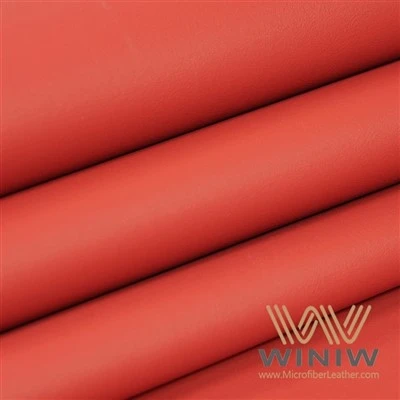
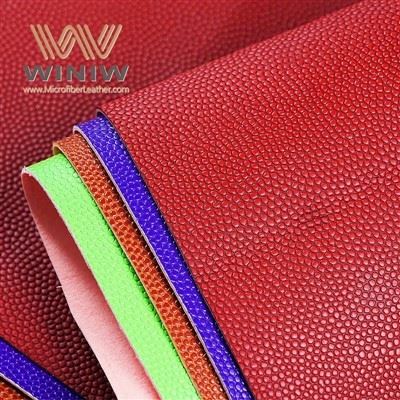
Microfiber leather for bags replicates the exact tactile drape and structural yield of premium calfskin through a 3D electrospun sea-island matrix. This non-woven polyurethane composite eliminates edge fraying during raw edge (cut-edge) processing, directly increasing edge painting efficiency for luxury handbag manufacturing.
Structural Drape and Mechanical Yield (EN ISO 3376)
Standard PU synthetics rely on knitted polyester backings, causing unnatural geometric stiffness and prominent creases when inverted or folded during bag assembly. A premium Luxury faux leather supplier engineers the drape coefficient by modifying the base polyethylene terephthalate (PET) fiber density.
By controlling the alkaline reduction phase, the substrate achieves an exact softness matching 1.2mm calfskin. It records an EN ISO 3376 tensile extension of ≥ 35% without breaking the surface grain, ensuring the material cascades naturally under its own weight for unstructured tote and hobo silhouettes.
Procurement & QA Notice: Validating raw edge mechanical properties for an upcoming luxury tote assembly? Request a physical sample roll and our ISO 9001 certified laboratory Technical Data Sheet (TDS).
Request Physical Swatches & Lab TDS Report for Bags/Leather Goods
Edge Painting Efficiency: The Raw Edge Advantage
In luxury leather goods, edge finishing requires a stable, monolithic cross-section. Flat woven substrates fray upon CAD/CAM die-cutting, requiring 3 to 4 rounds of base coat sanding and manual edge sealing to hide protruding polyester threads.
The 3D sea-island structure of our microfiber maintains strict dimensional stability. When die-cut, the edges remain perfectly sharp with zero protruding fibers. This reduces edge painting application cycles by 50%, requiring only one base coat and one top coat to achieve a perfectly domed edge.
| Processing Metric | Standard Woven PU (1.2mm) | Microfiber Leather (1.2mm) | Genuine Calfskin (1.2mm) |
| Drape Coefficient / Softness | High Stiffness (Creases) | Calfskin Equivalent | Standard Baseline |
| Raw Edge Fraying | High (Woven threads) | Zero (Non-woven 3D core) | Zero |
| Edge Paint Adhesion | Poor (Requires sealing) | Excellent (ISO 2411 ≥ 30 N/3cm) | Excellent |
| Thickness Tolerance | ± 0.15mm | ± 0.05mm | ± 0.20mm (Natural variance) |
| Tear Strength | ≤ 25 N | ≥ 60 N (EN ISO 3377-2) | 40 - 60 N |
By utilizing DMF-free water-borne polyurethane, the material prevents chemical interaction with edge paint solvents, preventing edge cracking or stickiness under thermal aging (ISO 188, 70°C). Specifying precise microfiber leather for bags guarantees 100% cutting yield, directly outperforming the 60-65% usable area of natural hides.
Frequently Asked Questions
Q: How does microfiber leather mimic the drape of real calfskin?
A: It utilizes a 3D electrospun sea-island PET matrix impregnated with polyether polyurethane. This non-woven architecture structurally mirrors natural collagen fibers, delivering an identical tactile softness, mechanical yield, and drape coefficient without the geometric stiffness of standard woven PU.
Q: Why is microfiber superior for raw edge handbag construction?
A: Unlike standard synthetic leather with knitted backings that fray when cut, microfiber features a monolithic, non-woven core. Die-cut edges remain perfectly smooth with zero protruding fibers, reducing edge painting and sanding cycles by up to 50%.
Q: What is the tear strength of this material for load-bearing straps?
A: Engineered microfiber substrates specifically formulated for handbag straps maintain an EN ISO 3377-2 tear strength of ≥ 60 N. This high mechanical capacity prevents elongation and structural failure under continuous heavy load.