Automotive interior materials exposed to extreme solar loads must resist both photo-oxidative degradation and thermal volatile off-gassing. Engineering-grade microfiber suede integrates hindered amine light stabilizers (HALS) and DMF-free polyurethane to simultaneously achieve ≥ Grade 4 colorfastness under Xenon arc exposure and strict VDA 277 VOC compliance.
Solar Load Mechanics: Photo-Oxidation and VIAQ Compliance
When vehicle cabins are subjected to direct solar radiation, dashboard and seating surface temperatures frequently exceed 85°C. This extreme thermal and ultraviolet load triggers two catastrophic failures in standard synthetic leather: polymer chain scission (causing surface cracking) and the rapid off-gassing of residual solvents (causing windshield fogging and toxic cabin odor).
To engineer an Anti-aging car interior leather, the base polymer chemistry requires modification. Our production lines utilize a 100% water-borne, DMF-free polyurethane coagulated within a sea-island polyethylene terephthalate (PET) matrix. During the slurry compounding phase, specific UV absorbers and HALS are distributed volumetrically throughout the resin. This prevents UV photons from breaking the polyether bonds, maintaining the material's structural elasticity (Bally flexing > 100,000 cycles) and ensuring Vehicle Interior Air Quality (VIAQ) emissions remain ≤ 10 mg/kg even under continuous thermal stress.
Procurement & QA Notice: Validating UV degradation limits and VIAQ parameters for a Tier 1 OEM assembly? Request a physical sample roll and our certified laboratory Technical Data Sheet (TDS).
Request Physical Swatches & Lab TDS Report for UV resistant faux suede
Laboratory Benchmarks: SAE J2412 and VDA Specifications
Subjective assessments of fading or odor are invalid in automotive QA. Material specifications dictate quantitative verification using accelerated weathering chambers and gas chromatography. The following matrix contrasts standard market PU against our engineered automotive micro suede.
| Physical Property / Protocol | Standard PU Leather | UV-Treated Micro Suede | Automotive OEM Tolerance |
| Accelerated UV Aging | Grade 2 - 3 (Fading) | Grade 4 - 5 | SAE J2412 / ISO 105-B06 |
| Thermal Aging (120°C, 500h) | Surface cracking | Pass (No visual degradation) | ISO 188 |
| VOC Emissions (Total Carbon) | > 80 μgC/g | ≤ 15 μgC/g | VDA 277 (≤ 30 μgC/g) |
| FOG Emission (Gravimetric) | > 5.0 mg | ≤ 1.5 mg | DIN 75201-B (≤ 2.0 mg) |
| Peeling Strength (Post-Aging) | ≤ 15 N/3cm | ≥ 30 N/3cm | ISO 2411 |
| Hydrolysis Resistance | 1 - 2 Weeks | > 5 Weeks | SATRA TM344 (70°C, 95% RH) |
Specifying Substrates for High-Exposure Cabin Components
For a direct Durable auto upholstery wholesale supplier, aligning the substrate thickness and UV package to the specific cabin component is mandatory to prevent warranty claims.
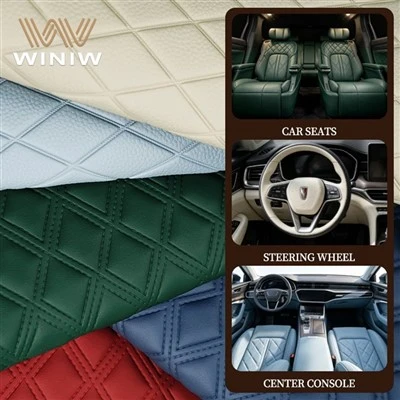
- Instrument Panels (Dashboards): Experience maximum direct UV index and heat soak. The material must exhibit a thermal shrinkage rate of < 1.5% at 120°C to prevent edge curling and delamination from the underlying ABS/PC substrate.
- Steering Wheels: Suffer from combined UV radiation and lactic acid transfer from human hands. The DMF-free matrix resists chemical cleavage, while the deep-vat disperse dyeing prevents dye migration onto occupant hands.
- Car Seats: Require high tensile capacity under thermal load. The 3D electrospun Microfiber Suede core evenly distributes occupant weight, preventing the localized stretching (puddling) often seen in degraded standard vinyl after 24 months of field use.
Initiate Custom UV & Emission Testing and Request a Wholesale Quotation
Frequently Asked Questions
Q: How is UV resistance tested for automotive microfiber?
A: Laboratories utilize Xenon arc weathering testers following SAE J2412 or ISO 105-B06 protocols. The material is subjected to controlled irradiance, heat, and humidity cycles. Post-exposure color fading is quantitatively measured via spectrophotometer and graded against a standard grayscale (Grade 1 to 5).
Q: Why do standard car seats crack under prolonged sun exposure?
A: Standard synthetic leather absorbs high-energy UV photons, causing photo-oxidative degradation that cleaves the polymer chains. Concurrently, thermal heat accelerates the evaporation of chemical plasticizers. This dual loss leaves the polymer matrix rigid, brittle, and prone to rapid mechanical cracking.
Q: What is VDA 277 and why does it matter for UV-exposed leather?
A: VDA 277 is a German automotive standard measuring total VOC emissions. When materials heat up under direct UV/solar load, residual solvents vaporize rapidly. Compliant microfiber must record total carbon emissions below 30 μgC/g to prevent toxic cabin odors and interior fogging.