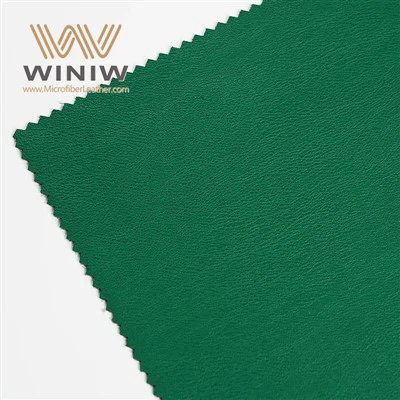
Material Overview
Technical Specifications and Environmental Standards
|
Environmental Metric
|
Verified Technical Value
|
Conventional Solvent PU
|
Reference Test Protocol
|
Sourcing Compliance Status
|
|---|---|---|---|---|
|
DMFa Residue
|
DMF-free (< 10 ppm)
|
100 - 500 ppm
|
GC-MS Extraction
|
REACH SVHC Compliant
|
|
Recycled Content
|
30% to 100% GRS rPET
|
0% (Virgin Polyester)
|
GRS 4.0 Certification
|
Certified Recycled
|
|
Bio-Based Carbon
|
20% to 50% Content
|
0% (Petroleum-based)
|
ASTM D6866 (C14)
|
USDA BioPreferred Match
|
|
Total VOC Emissions
|
< 10 ugC/g (Low odor)
|
> 100 ugC/g (Strong smell)
|
VDA 278 Gas Chromatography
|
Passed Automotive Standards
|
|
Heavy Metals
|
0% Lead, Cadmium, Chrome VI
|
Trace catalysts found
|
EN 71-3 / EPA 3052
|
RoHS Certified
|
|
Phthalate Plasticizers
|
0% (15P / 6P free)
|
High in cheap vinyls
|
EN 14372 / GC-MS
|
CPSIA / Prop 65 Compliant
|
Types of Environmentally Friendly Synthetic Leather
WINIW's eco-friendly synthetic leathers are of various types to meet the needs of different customers. They mainly include:


Material Structure Selection: Sustainable Chemical Formulations
Common applications of environmentally friendly synthetic leather
WINIW's environmentally friendly synthetic leather is widely used in many fields:

Such as sofas, chairs, decorative panels, etc., to add green elements to the home environment.

Such as seats, interior panels, etc., to improve the comfort and environmental performance of the car.

Bags and clothing
Such as handbags, backpacks, shoes, clothing, etc., to meet consumers' dual demands for fashion and environmental protection.

Smart wearable electronic products
Such as smart watches, bracelets, etc., inject environmental protection concepts into electronic products.
Application-Specific Eco-Friendly Solutions
- Safety & Work Footwear (EN ISO 20345): REACH-compliant, breathable microfiber suede and PU linings that wick sweat away from the foot, engineered to pass strict orthopedic and safety parameters without toxic heavy metal finishes.
- Automotive Interiors (IATF 16949): Ultra-low VOC, low-odor solvent-free PU and silicone leathers that meet strict VDA 278, VDA 270, and ISO 3795 flammability standards, ensuring a healthy cabin environment without fogging.
- Commercial & Hospitality Furniture: Durable GRS-recycled polyurethane and silicone fabrics designed to survive over 100,000 Martindale rubs, complying with CAL TB 117-2013 flammability codes natively.
- Luxury Bags & Premium Packaging: Ultra-thin, odor-free, sulfur-free microsuede and polyurethane wrapping materials designed to protect delicate gold and silver accessories from oxidation and tarnishing.
Our Closed-Loop Custom Engineering Process
- Standard Analysis: You provide your target regulatory or industry codes (e.g., IATF 16949, EN ISO 20345, BS 5852 Crib 5).
- Formulation Matching: Our laboratory adjusts polymer cross-linking density, UV stabilizers (HALS), plasticizer molecular weights, and backing fibers.
- Pilot Lab-Dip Production: We manufacture physical swatches matching your custom Pantone color and gloss levels within 7 to 10 days.
- On-Site Destructive Testing: Swatches undergo Wyzenbeek double rubs, tropical chamber hydrolysis, and vertical flammability tests to verify compliance.
- Traceable Mass Production: Once approved, volume production is completed within 15 to 20 days with strict batch-code traceability.
Sourcing Policy: MOQ, Lead Time, and Packaging
- Minimum Order Quantity (MOQ): Our standard custom manufacturing MOQ for eco-friendly microfiber substrates is 300 linear meters per color and thickness. For standard PU or PVC formulations, the MOQ is 1,000 linear meters per color and thickness. For standard program stocks in black or white, we can dispatch trials starting from 100 linear meters to support your prototyping.
- Color Matching Consistency: Lot-to-lot color shading (ΔE) is a critical quality concern for automated assembly lines. Our laboratory utilizes automated gravimetric pigment dispensers and Datacolor spectrophotometers to maintain the overall color difference strictly under ΔE≤0.82 under standard D65 illuminants.
- Packaging and Transport: All bulk rolls are packed in dual-layer PE moisture-barrier roll wrapping with heavy-duty woven outer PP bags and labeled with unique traceable batch-code roll IDs.
Buyer Sourcing FAQs
Q: What is the difference between GRS certification and generic recycled claims?
A: Generic recycled claims often lack third-party validation and supply chain transparency. The Global Recycled Standard (GRS) is an international, voluntary product standard that sets requirements for third-party certification of recycled input, chain of custody, social and environmental practices, and chemical restrictions. To verify compliance, WINIW provides an official Transaction Certificate (TC) for every GRS-recycled bulk contract, proving the recycled content can be traced back to the post-consumer feedstock.
Q: Do bio-based or recycled polyurethanes degrade faster than petroleum-based ones?
A: No. The physical durability of polyurethane depends on the cross-linking density and polymer grade (ether/ester/carbonate), not on whether the polyols are derived from petroleum or plants. WINIW bio-based and rPET microfiber formulations utilize highly stable polyether structures, ensuring they maintain identical abrasion resistance (>100,000 Martindale rubs) and hydrolysis resistance (>5 weeks SATRA TM344) to standard petroleum-based synthetic leathers.
Contact Our Engineering Materials Team
- Plant Footprint: 100,000 m² total manufacturing area
- Annual Output: 2,000,000 meters of high-grade synthetic roll goods
- On-Site Lab: Certified thickness gauges, tensile testers, and Bally flex chambers
- Direct Inquiry Email: MKT@MicrofiberLeather.com
- B2B WhatsApp: +8618150976625
- Corporate Address: 3rd Floor, Huixia Building B, Meiling Street, Jinjiang, Quanzhou, Fujian 362200 China
Hot Tags: environmentally friendly synthetic leather, China environmentally friendly synthetic leather manufacturers, suppliers, factory