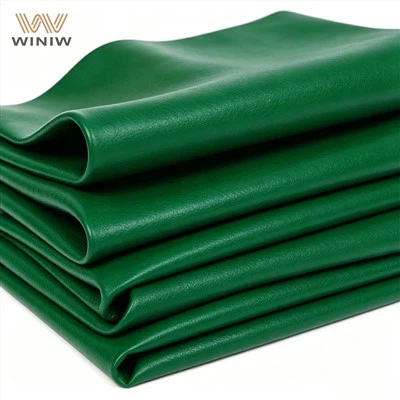
Global synthetic leather procurement operates on a dual-metric system where one linear meter strictly equals 1.0936 yards. When standardizing continuous roll goods at an industrial fixed width of 1.37 meters (54 inches), calculating the exact price per linear unit versus total square area yield is required to prevent a 9.36% volume discrepancy in landed material costs.
Linear Conversion and Surface Area Mathematics
When evaluating procurement contracts, purchasing directors must distinguish between linear measurement (length) and volumetric yield (surface area). Standard engineering-grade microfiber leather, manufactured via sea-island electrospinning, is supplied in continuous rolls with a guaranteed usable width of 1.37m.
This fixed width means a linear measurement directly dictates the CAD/CAM CNC nesting capacity. The following matrix defines the exact dimensional output per unit.
| Metric | Meter-Based Procurement | Yard-Based Procurement | Conversion Standard |
| Linear Length | 1.000 Meter | 1.000 Yard (0.914 Meters) | 1 Meter = 1.0936 Yards |
| Standard Usable Width | 1.37 Meters | 54 Inches (1.37 Meters) | Physical Roll Dimension |
| Total Surface Area | 1.37 Square Meters (sqm) | 1.25 Square Yards (1.04 sqm) | Length × Width |
| Structural Yield | Base Baseline (100%) | - 8.56% usable area | Area Comparison |
Procurement & QA Notice: Need to physically verify thickness tolerance (±0.05mm) and usable width on your automated cutting systems? Request a 5-meter sample roll and our ISO 9001 factory Technical Data Sheet (TDS).
Request Physical Swatches & Lab TDS Report
Normalizing Quotations: Cost Calculation Models
When a synthetic leather supplier issues an Ex-Works (EXW) quotation, the chosen metric fundamentally alters the budget baseline. A quote of $10.00 per yard appears financially superior to $10.50 per meter until normalized.
To determine the true cost, you must standardize the metric.
- Yard to Meter Formula: Price per Yard × 1.0936 = True Price per Linear Meter
- Linear to SQM Formula: Price per Linear Meter ÷ 1.37 = Price per Square Meter
| Supplier Quote | Normalized Linear Meter Cost | Normalized Square Meter (SQM) Cost | Financial Reality |
| Supplier A: $8.50 / Yard | $9.30 / Meter | $6.78 / SQM | Appears cheaper; actually costs 3.3% more. |
| Supplier B: $9.00 / Meter | $9.00 / Meter | $6.56 / SQM | Statistically lower procurement cost. |
Maximizing Material Yield and Industrial Specifications
Securing an optimized microfiber leather price per meter is financially invalid if the substrate presents edge curling or thickness variations exceeding ±0.05mm. In automated footwear and auto interior nesting, dimensional instability forces R&D engineers to increase safety margins between die-cut patterns, instantly generating 5-10% material waste.
Direct source factories producing DMF-free, polyether-based polyurethane composites ensure 100% usable width across the entire 1.37m span. Because the material relies on an integrated non-woven structure rather than a superficial PU coating, the structural integrity (ISO 2411 peeling strength ≥ 30 N/3cm) remains perfectly uniform from the core to the selvedge edges.
Explore All Product Categories to Review Material Specifications and Request a Bulk Quotation
Frequently Asked Questions (FAQ)
Q: How do you convert the price per yard to the price per meter?
A: Multiply the given price per yard by 1.0936. For example, if a factory quotes $8.00 per yard, the exact linear meter cost is $8.75 ($8.00 × 1.0936). This normalization is strictly required for accurate vendor comparisons.
Q: What is the standard width of an industrial microfiber leather roll?
A: The standardized usable width is 1.37 meters, equivalent to 54 inches. This fixed horizontal dimension allows continuous, uninterrupted processing on automated multi-layer CAD/CAM cutting tables without the need for edge trimming.
Q: Does roll width affect the total square meter cost for footwear nesting?
A: Yes. One linear meter at a standard 1.37m width yields exactly 1.37 square meters of usable material. Purchasing managers must divide the linear meter price by 1.37 to calculate the true cost per square meter for precise Bill of Materials (BOM) budgeting.