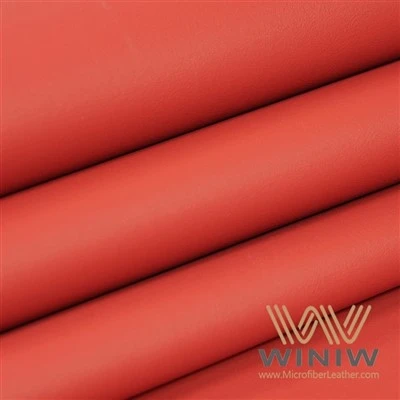
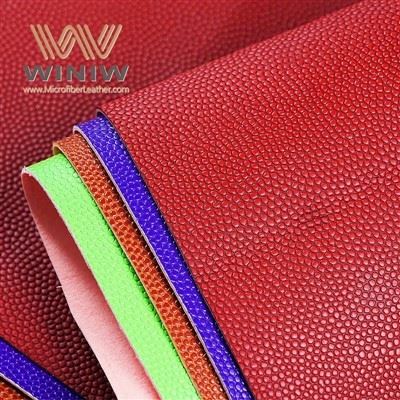
The surface topology of embossed micro suede directly dictates the commercial margin of final bag and leather goods applications, extending beyond mere visual color formulation. WINIW International Co., Limited engineers 3D textures reaching 0.8mm in depth via precise release paper transfer and steel roller thermo-mechanical processes, strictly maintaining an EN ISO 3377-2 tear strength of ≥ 60 N across the 3D sea-island polyethylene terephthalate (PET) matrix.
Thermodynamics of Release Paper Transfer
Manufacturing premium 3D texture synthetic leather requires bypassing direct physical hot-pressing that crushes the micro-fibrous nap and degrades tactile friction. To realize complex crocodile or lychee topologies while preserving a soft touch, QA and R&D engineers specify high-precision release paper transfer.
Water-borne polyurethane (PU) is precision-coated onto a negative-texture release paper and pre-cured in a 150°C controlled oven. Utilizing a 100% DMF-free wet coagulation process, this textured PU film is thermally bonded to the 3D sea-island PET non-woven substrate. Because no destructive mechanical shear is applied to the base, the material physically retains an ISO 2411 peeling strength of ≥ 30 N/3cm, eliminating stress-concentration fractures at the root of deep geometric patterns.
Procurement & QA Notice: The depth of an embossed pattern is often inversely proportional to base tear strength. Prevent substrate embrittlement on your automated cutting floor. Submit your CAD texture files and request physical lab-dips specifically engineered for Bags/Leather Goods today.
CNC Steel Roller Embossing and Gauge Tolerance
For custom faux leather patterns requiring extreme surface compressive strength, WINIW deploys direct thermo-mechanical embossing via CNC-engraved heated steel rollers. Roller surface temperatures are strictly maintained at 180°C ± 2°C with an applied mechanical load of 50 to 80 bar.
This extreme thermodynamic load forces the polycarbonate PU topcoat into immediate permanent plastic deformation, locking in the 3D texture. To prevent aggressive gauge compression that drops sewing line yields, our continuous reverse roll coating lines restrict the base thickness tolerance to ±0.05mm prior to embossing.
| Physical / Process Parameter | Standard Embossed PU | WINIW 3D Micro Suede | Testing Protocol |
| Peeling Strength (Tensile) | ≤ 15 N/3cm (Root cracking) | ≥ 30 N/3cm (Structurally intact) | ISO 2411 |
| Tear Strength (Z-Axis Load) | < 40 N | ≥ 60 N | EN ISO 3377-2 |
| Gauge & Texture Tolerance | ± 0.20mm (Causes needle breaks) | ± 0.05mm (High consistency) | Inline Laser Caliper |
| VOC Emissions (DMFa) | > 300 mg/kg | 0 mg/kg (DMF-free) | VDA 277 / EN 16778 |
| Surface Abrasion (Martindale) | 30,000 Rubs (Pattern flattens) | > 100,000 Rubs (Topology remains) | EN ISO 12947-2 |
Even under severe structural embossing, the cross-linked matrix easily survives > 100,000 continuous rubs (EN ISO 12947-2) without flattening or losing topological definition.
Reject mechanical degradation caused by uncalibrated embossing. Lock in your specific CIELAB color targets and 3D depth parameters with WINIW International Co., Limited, and request factory-direct TDS metrics for your Bags/Leather Goods procurement run today.
Frequently Asked Questions (FAQ)
Q: How does embossed micro suede maintain its 3D texture over time?
A: WINIW utilizes 180°C CNC thermo-mechanical rollers and release paper transfer to induce permanent plastic deformation in the polycarbonate PU. This engineered structure withstands > 100,000 Martindale abrasion rubs (EN ISO 12947-2), preventing the pattern from flattening during physical friction.
Q: Do custom faux leather patterns decrease material tear strength?
A: No. By impregnating water-borne PU directly into a 3D sea-island PET matrix, the substrate forms a mechanically interlocked structure. Even with 0.8mm deep embossing, the material stably maintains an EN ISO 3377-2 tear strength of ≥ 60 N, preventing sewing line fractures.
Q: What are the environmental standards for 3D texture synthetic leather?
A: The embossing and coagulation processes are 100% DMF-free. Volatile Organic Compound (VOC) emissions are strictly restricted to 0 mg/kg, fully complying with EU REACH Annex XVII limits and ZDHC Level 3 chemical safety regulations.