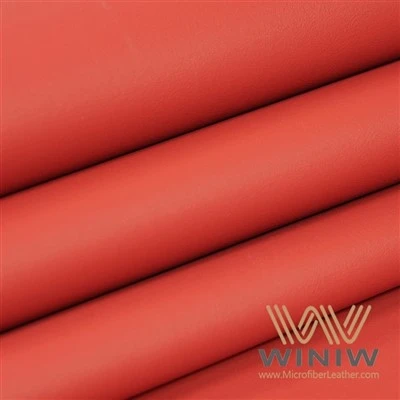
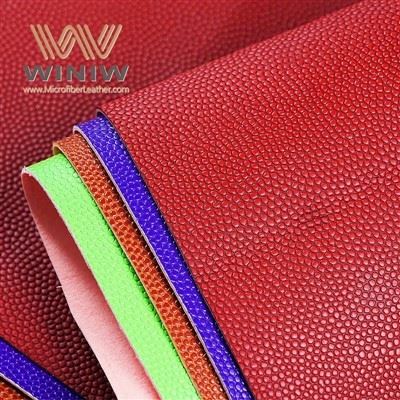
Custom embossed microfiber leather utilizes high-pressure thermal calendering and specialized release paper to replicate natural hide grains and geometric patterns with exact 1:1 precision. By modifying the polyurethane surface tension during the curing phase, engineering-grade substrates achieve any structural finish-from deep litchi grains to technical carbon fiber matrices-while maintaining strict EN ISO mechanical compliance.
The Thermal Calendering & Release Paper Mechanism
Achieving exact texture replication requires controlling the thermal transfer interface. Standard flat PU utilizes a smooth release paper. For texture modification, we deploy custom-molded release paper during the dry polyurethane (PU) coating phase. Under calibrated thermal load (typically 150°C to 160°C) and strict mechanical pressure, the liquid PU resin cures directly into the microscopic cavities of the geometric mold.
Because the base matrix is a dense sea-island non-woven structure rather than a flat knitted fabric, it provides rigid physical support. This underlying density prevents the embossed pattern from flattening or deforming under continuous mechanical flexing (> 100,000 cycles, EN ISO 5402-1). The result is a permanent structural grain that mimics the exact light refraction and tactile drag coefficient of the original target material.
Procurement & QA Notice: Need to validate grain retention for an upcoming product line? Send your physical reference swatch for a 1:1 CAD analysis and request our laboratory Technical Data Sheet (TDS).
Request Physical Swatches & Lab TDS Report for Custom texture synthetic leather
Engineering Timelines: Tooling, Sampling, and Mass Production
For procurement directors (CPOs) managing strict Bill of Materials (BOM) schedules, establishing reliable lead times for custom material engineering is mandatory. The matrix below outlines the standard operational cycle required to convert a physical reference sample into a mass-produced custom roll.
| Production Phase | Timeline Execution | Technical Output / QA Metric |
| Phase 1: Pattern Analysis & CAD | Days 1 - 3 | Optical scanning of reference sample, 3D topographical mapping. |
| Phase 2: Custom Tooling | Days 4 - 10 | Manufacturing of specialized release paper / embossing rollers. |
| Phase 3: Lab-Dip & Prototyping | Days 11 - 15 | Physical 5-meter pilot run. Verification of ΔE ≤ 0.82 color match. |
| Phase 4: Client QA Approval | Dependent on Client | Physical stress testing (e.g., ISO 2411 peeling strength verification). |
| Phase 5: Mass Production | Days 16 - 25 | Output of bulk contract (≥ 1,000 meters). Dimensional tolerance ±0.05mm. |
Mechanical Retention in Heavy Luggage and Handbags
Deep embossing profiles-such as heavy crocodile, coarse pebble, or full-grain litchi textures-compress the Z-axis of the material. In standard commercial PU leather, this intense thermal compression fractures the base fabric, dropping tear strength below 20 N.
As a direct Embossed microfiber supplier, our production lines utilize a 3D electrospun PET core deeply impregnated with DMF-free polyether polyurethane. The volumetric density of this sea-island matrix absorbs the mechanical pressure of the embossing roller without fracturing internal fiber bundles. This guarantees that heavily textured materials specified for Bags & Leather Goods maintain an EN ISO 3377-2 tear strength of ≥ 60 N and an ISO 2411 peeling strength of ≥ 30 N/3cm, completely eliminating the risk of structural failure at stitching seams.
Initiate Custom Texture Tooling & Request a Wholesale Quotation
Frequently Asked Questions
Q: How accurate is the 1:1 texture matching for synthetic leather?
A: Accuracy is strictly controlled via high-resolution optical scanning and CAD mold formulation. The resulting release paper replicates the exact microscopic topography of the reference sample, ensuring a 1:1 visual and tactile match with consistent lot-to-lot replication across high-volume production.
Q: Does deep embossing reduce the tear strength of microfiber leather?
A: No. Engineering-grade microfiber uses a dense 3D sea-island PET matrix that structurally supports deep thermal compression. Unlike standard knitted PU, the non-woven core absorbs the embossing pressure without fiber fracture, maintaining a tear strength ≥ 60 N (EN ISO 3377-2).
Q: What is the lead time for custom embossed microfiber leather?
A: The standard lead time from receiving your physical reference sample to dispatching a physical material prototype is 10 to 15 days. Once your QA team approves the prototype, mass production of the bulk order requires an additional 10 to 15 days.