

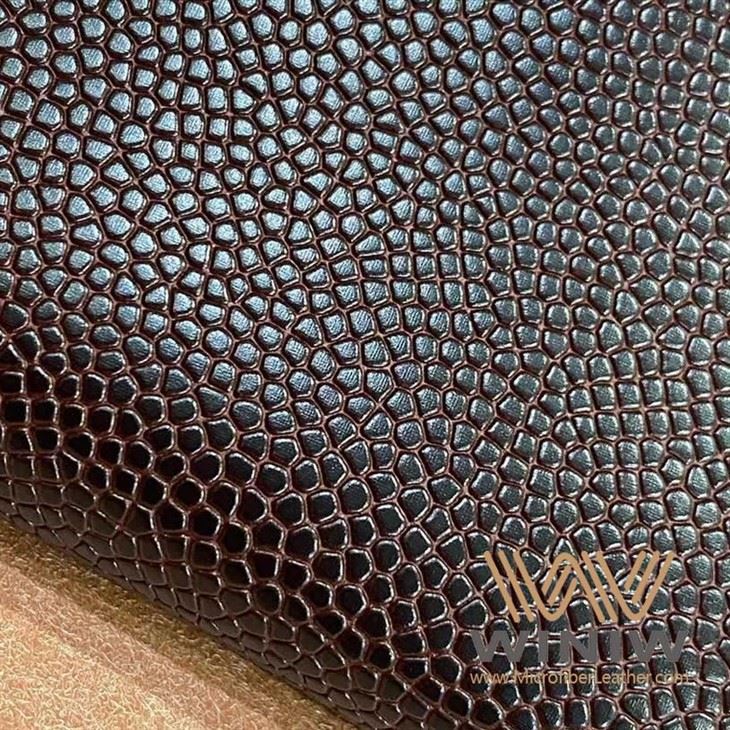
Material Introduction

In the manufacturing of aerodynamic sports balls (such as soccer balls and volleyballs), dimensional stability is the absolute baseline. When a soccer ball is struck at high velocity, standard low-density PU or PVC stretches unevenly. Over a short period, the ball loses its perfectly round shape (out-of-roundness), balloons at the seams, and becomes unplayable. Furthermore, if the material is porous, it absorbs rainwater, drastically increasing the ball's weight and altering its flight trajectory.
We formulated our High Density Pu Material For Ball to provide rigid structural integrity without sacrificing the player's soft tactile touch. The substrate utilizes an advanced high-density microcellular polyurethane foam layer. This dense molecular structure acts as a shock absorber during high-velocity impacts, rapidly dissipating kinetic energy while instantly recovering its exact original shape. It registers a tensile strength of ≥ 30 Mpa, preventing the geometric panels from stretching under internal bladder pressure. Completely hydrophobic, the topcoat restricts water absorption to under 10%. Whether utilized for traditional machine-stitching or modern seamless thermal bonding, this high-density matrix ensures your final product maintains its exact weight, circumference, and aerodynamic flight path.
Physical Properties & Specifications
| Technical Parameters | Sporting Goods Engineering Data |
| Material Base | High-Density Microcellular PU + Isotropic Backing |
| Standard Caliper | 1.2mm / 1.5mm (Strict Tolerance: ±0.03mm) |
| Roll Width | 54 inches (137cm - Maximizes geometric cutting) |
| Tensile Strength | ≥ 30 Mpa (Maintains strict spherical stability) |
| Impact Endurance | > 5000 Cycles @ High Velocity (Zero ballooning) |
| Water Absorption | < 10% Weight Gain (All-weather performance) |
| Bonding Affinity | Compatible with thermal vulcanization & industrial glues |
| Eco-Compliance | REACH SVHC Passed, Zero Heavy Metals |

Competitive Material Analysis
For sporting goods production engineers calculating the Bill of Materials (BOM), selecting the correct substrate density dictates the final tier classification (training vs. match ball) and overall warranty defect rates.
- Vs. Low-Density PU & PVC: Cheap synthetic materials use air-filled, low-density foam layers to mimic softness. Under the repeated stress of kicking or spiking, these weak air pockets collapse. The ball develops hard spots, the seams stretch, and the ball turns oval. Our high-density microcellular PU relies on tightly packed polymer cross-linking. It provides a premium, cushioned touch while retaining massive internal structural rigidity, preventing out-of-roundness even under extreme professional gameplay.
- Vs. Genuine Animal Hide: Natural leather absorbs water instantly. During a rainy outdoor match, a leather ball will double in weight, slowing down the game and risking player injury. Additionally, natural hide stretches unpredictably depending on the direction of the grain. Our engineered PU is strictly hydrophobic and highly isotropic-meaning it possesses identical tensile strength in all directions. It guarantees a 100% automated cutting yield on 54-inch rolls and ensures the ball behaves predictably regardless of which panel is struck.


Industry Applications
Because of its verified spherical stability, high-velocity impact endurance, and waterproof physics, this substrate is specified for rigorous sporting equipment:
- Thermal Bonded Soccer Balls: Seamless match balls requiring absolute water resistance and high-temp gluing stability.
- Professional Volleyballs: Requires the high-density cushioned foam to absorb shock and prevent player sting during heavy spikes.
- Rugby & American Footballs: Dense structural matrices that withstand brutal abrasion and retain complex oval geometries.
- Heavy Training Equipment: Medicine balls and weighted slam balls relying on maximum tensile strength to contain dense internal cores.

Why Source From WINIW Factory?
WINIW International Co., Limited operates as an engineering-focused manufacturing facility in China, heavily prioritizing technical material execution. Producing tournament-grade sporting goods requires absolute zero tolerance for thickness variations and anisotropic stretching-metrics that standard bag leather factories simply do not measure. We bypass trading agencies entirely. As your direct manufacturer and factory partner, we control the high-density PU coagulation, the structural backing calibration, and the final surface finishing entirely in-house. Our testing lab verifies the tensile strength and impact resistance of every commercial batch before shipment. Contact our engineering team for targeted technical data sheets, physical A4 lab dips, and exact direct-source pricing to optimize your high-performance ball production lines.


Quality Assurance: Our commitment to producing high-quality, eco-friendly artificial leathers ensures durability and aesthetic appeal, meeting international standards .
Innovative Range: Continuous research and development result in a cutting-edge portfolio, including ultra-realistic textures and sustainable options, keeping us ahead in the market .
Customizable Solutions: We offer bespoke services to tailor leather specifications according to client needs, fostering long-term collaborations and satisfaction .
Efficient Production: Advanced manufacturing processes and streamlined logistics guarantee timely delivery, minimizing lead times and enhancing business efficiency for our clients .


FAQ
Q: How does this high-density PU prevent the ball from losing its shape?
A: Loss of shape (out-of-roundness) occurs when the material's backing stretches unevenly under impact and internal bladder pressure. We engineer this substrate with a tension-calibrated, isotropic backing combined with a high-density PU foam. It registers a tensile strength of ≥ 30 Mpa in all directions. This uniform structural rigidity prevents individual geometric panels from warping, ensuring the ball remains perfectly spherical.
Q: Is this material suitable for seamless thermal bonding production lines?
A: Yes. Modern match balls utilize thermal bonding instead of stitching to eliminate water entry. Our high-density PU is chemically formulated to cross-link seamlessly with industrial thermal adhesives. It withstands the heat and pressure of the spherical molding process without the topcoat melting or the foam layer collapsing.
Q: Will the material absorb water during heavy rain?
A: No. Waterlogging is a critical failure in outdoor sports. We apply a strictly hydrophobic polymer topcoat and utilize a closed-cell microcellular foam structure. Laboratory tests confirm a water absorption rate of < 10%. The ball will not absorb mud or rainwater, maintaining its exact regulation weight and aerodynamic balance throughout the match.
Q: What is the minimum order quantity (MOQ) and production origin?
A: As a direct B2B supplier, our wholesale MOQ is 500 linear meters per specific pantone color, texture, and thickness. All continuous rolls are manufactured under strict quality control directly at our facility in China.
We are eagerly looking forward to receiving your inquiry!
Hot Tags: high density pu material for ball, China high density pu material for ball manufacturers, suppliers, factory, polyurethane for leather, pu bag, polyurethane pu leather, pu leather cord, urethane leather, sewing pu leather


